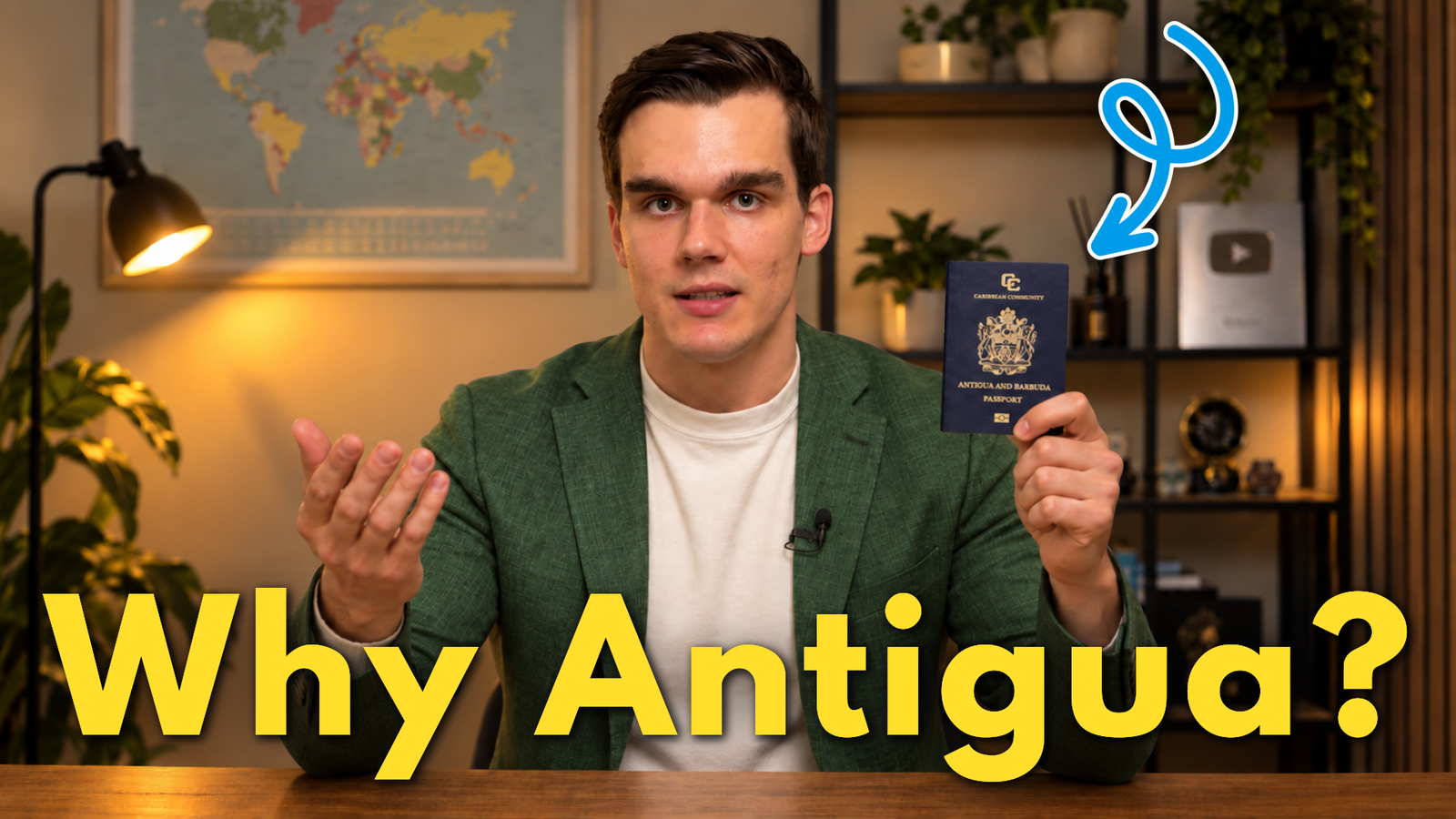
There are currently five Caribbean countries offering established citizenship-by-investment programs: Antigua and Barbuda, St. Kitts and Nevis, Grenada, Dominica and Saint Lucia.
On paper, they can look remarkably similar. Their passports offer broadly comparable international mobility, their investment thresholds sit within a relatively narrow range, and all five provide a direct route to citizenship through a qualifying contribution or investment.
In practice, however, the differences become much more significant.
For most of our clients, Antigua and Barbuda and St. Kitts and Nevis are the two programs we primarily work with. The reason is not simply passport strength. Pricing for families, dependent eligibility, processing, administration, taxation and the country behind the passport can matter just as much.
Do not compare Caribbean passports on mobility alone
The five programs offer broadly similar travel access. The more useful comparison is how the citizenship works as a long-term Plan B, including the application process, family eligibility, country, tax environment and future reputation of the program.
The Country Behind the Passport
One of Antigua and Barbuda’s strengths is that there is a relatively developed and functional country behind the citizenship program.
The economy is supported not only by citizenship-by-investment revenue but also by tourism, construction and financial services. There are real-estate and business opportunities, and although Caribbean property is generally expensive, Antigua can offer comparatively better value within the region.
Connectivity is another advantage. Antigua has one of the better-connected airports in the Caribbean, with direct flights to the United States, Canada and the United Kingdom.
For someone who might actually need to use their Plan B one day, infrastructure matters. Antigua offers private healthcare and schooling options and the basic infrastructure required to establish a normal life.
This consideration should not be overstated because citizens of the five countries benefit from regional mobility through the Eastern Caribbean. But it does mean Antigua itself can be a credible place to spend time rather than simply a jurisdiction issuing a useful passport.
OECS Free Movement Changes the Comparison
All five countries participate in the OECS free-movement framework in the Eastern Caribbean.
This gives their citizens the ability to live and work across participating member states. Someone obtaining Grenadian citizenship, for example, is not necessarily limited to living in Grenada and can also benefit from regional mobility that includes Antigua and Barbuda.
That reduces the importance of comparing the five programs purely according to which individual island someone would prefer to live on.
There are also differences in international visa-free access. Saint Lucia, for example, does not provide the same visa-free access to China or Russia described for some alternatives, while Antigua does not provide visa-free access to Argentina.
Overall, however, the international mobility profiles remain relatively similar.
Tax Can Matter If Your Plan B Becomes Plan A
Many citizenship-by-investment applicants do not intend to relocate to the Caribbean. That does not mean the domestic tax system should be ignored.
A genuine Plan B should still be evaluated on the assumption that you might eventually need to use it.
Antigua and Barbuda is particularly interesting in this respect because the source describes it as a tax-free jurisdiction for personal income and highlights a tax residency option requiring only 30 days of annual presence.
This has become increasingly relevant to internationally mobile entrepreneurs who want more than citizenship and may also want the possibility of establishing tax residence in the Caribbean.
St. Kitts and Nevis can offer a similarly tax-friendly environment. By comparison, the other three jurisdictions levy personal income taxes that can reach approximately 30%, according to the source.
A second citizenship should be assessed against the possibility that you may eventually need to live under that country’s rules. Travel access matters, but taxation, infrastructure and the ability to establish a practical life can become considerably more important if a backup jurisdiction ever becomes your primary base.
How Much Does Caribbean Citizenship by Investment Cost?
The contribution thresholds are relatively close for a single applicant.
| Country | Base Contribution | Relevant Distinction |
|---|---|---|
| Dominica | US$200,000 | Lowest stated entry contribution for a single applicant |
| Antigua and Barbuda | US$230,000 | Contribution remains US$230,000 with up to three dependents |
| Grenada | US$235,000 | Historically differentiated by access to the U.S. E-2 route |
| Saint Lucia | US$240,000 | Source reports significant current processing delays |
| St. Kitts and Nevis | US$250,000 | Highest base contribution but longest-running program |
For a single applicant, Dominica therefore appears less expensive than Antigua.
The calculation changes considerably when dependents are included.
Why Antigua Is Particularly Competitive for Families
Antigua’s US$230,000 base contribution does not increase when up to three dependents are included.
For a family of four, the contribution therefore remains US$230,000, with an additional government processing fee of approximately US$20,000.
Dominica, by comparison, starts at US$200,000 for an individual but increases to a US$250,000 contribution for a family of four.
Antigua also provides a separate route through the University of the West Indies Fund for families of at least six people. The contribution starts at US$260,000 and covers up to six family members.
Dependent eligibility is another important distinction.
Antigua has comparatively broad dependent rules. According to the source, siblings of either the main applicant or their spouse can potentially qualify for inclusion, subject to the program’s requirements.
For applicants with several dependents, these differences can materially change the total cost and practicality of the application.
Donation, Real Estate or Business Investment?
All five programs provide qualifying real-estate routes in addition to contribution options.
However, citizenship-linked real estate should be assessed carefully. The potential buyer pool can be heavily concentrated among future CBI applicants, while properties may carry higher prices, substantial agent commissions and ongoing maintenance costs.
The Caribbean’s exposure to hurricanes is another factor that should be incorporated into any property investment decision.
For these reasons, a qualifying real-estate purchase should not automatically be treated as economically superior simply because the capital is invested rather than donated.
Antigua’s Business Investment Route
Antigua also offers a dedicated business-investment route.
The minimum individual investment described in the source is US$1.5 million into an approved local business.
Unlike a non-refundable contribution, a genuine business investment creates the possibility of preserving capital and generating a return.
This route can therefore be relevant to entrepreneurs who have a commercial reason to establish or acquire a business in Antigua rather than simply seeking the lowest-cost route to citizenship.
Investing is not automatically cheaper than donating
A qualifying investment may preserve capital, but it also introduces commercial, liquidity and execution risk. The correct comparison is not simply the amount invested versus the amount donated, but the quality of the underlying asset and the realistic exit market.
Processing and Predictability Matter
One of the largest differences between Caribbean programs is harder to see on a pricing sheet: the actual application experience.
Due diligence, communication, banking, payment processing and administration all influence how smoothly an application progresses.
St. Kitts and Nevis has a particular advantage here because its program dates back to the 1980s. It is the longest-running citizenship-by-investment program in the region and has had decades to develop its procedures.
Antigua’s program is much younger, having launched in 2013, but the source describes its application process as similarly structured and predictable.
An applicant submits the required documentation, completes due diligence, makes the contribution and pays the remaining fees. The source gives an indicative timeframe of approximately four to six months for Antigua.
By contrast, Saint Lucia is described as experiencing significant backlogs, banking delays and longer processing times. Some applicants are reported to have waited more than 18 months, with certain cases approaching two years.
The cheapest passport can become expensive if the process goes wrong
Contribution thresholds are only one part of the decision. For applicants who value certainty, administrative predictability and communication can justify choosing a program that is not the absolute cheapest on paper.
Reputation and Long-Term Passport Value
The five countries also need to be considered in terms of international perception.
Dominica has faced greater reputational challenges and was the first of the programs discussed in the source to lose visa-free access to the United Kingdom and Ireland.
St. Kitts and Nevis is often viewed as the established program because of its age. That history has also meant considerable scrutiny from larger governments, particularly the United States and Europe.
Despite periods of controversy and external pressure, the program has continued operating.
Antigua has generally attracted less attention. Combined with its broader economy and the country’s underlying infrastructure, this contributes to the source author’s preference for Antigua when considering longer-term program sustainability.
No citizenship-by-investment applicant should assume current visa-free access is permanent. Immigration policies are controlled by destination countries and can change after citizenship has been acquired.
Where Does the Contribution Go?
Applicants may also care about how their contribution is used.
Under Antigua’s National Development Fund route, contributions support government-funded development and infrastructure.
The source highlights education as one example, including funding connected with a primary school project.
For applicants who view citizenship by investment partly as a contribution to the country granting citizenship, transparency around the use of funds can form part of the decision.
Antigua’s Five-Day Stay Requirement
One historical difference with Antigua has been its physical-presence requirement.
The source describes a requirement to spend at least five days in Antigua and Barbuda during the first five years after citizenship is granted.
For most internationally mobile applicants, five days over a five-year period is unlikely to be particularly restrictive.
More importantly, physical-presence requirements may become increasingly relevant across the Caribbean as programs respond to international pressure.
The source states that Grenada is introducing a significantly higher requirement of 30 days during the first five years.
What About Grenada and the U.S. E-2 Visa?
Grenada has historically occupied a distinctive position for applicants interested in the United States because it has an E-2 treaty with the U.S.
This allowed eligible Grenadian citizens to pursue an E-2 investor visa after acquiring citizenship and making the required U.S. investment.
However, the source states that people who acquired Grenadian citizenship through investment now need to have been domiciled in Grenada for three years before relying on that citizenship for the E-2 route.
For someone whose primary objective was to obtain Grenadian citizenship and immediately use it as a bridge to an E-2 visa, that significantly changes the proposition.
Comparing the Five Caribbean Citizenship Programs
| Program | Source Highlights | Source Concerns |
|---|---|---|
| Antigua and Barbuda | Family pricing, broad dependent rules, tax environment, infrastructure, business investment option | Five-day physical-presence requirement |
| St. Kitts and Nevis | Longest-running program, mature procedures, smooth processing | Higher contribution and greater historical international scrutiny |
| Grenada | Established program and E-2 treaty relationship | Three-year domicile issue for certain E-2 applicants and proposed stricter stay requirement |
| Dominica | Lowest stated contribution for a single applicant | Higher family contribution and greater reputational concerns in the source |
| Saint Lucia | Similar passport mobility and pricing | Reported backlogs, banking delays and long processing times |
How to Choose Between Caribbean CBI Programs
The right comparison depends heavily on the applicant.
A single applicant focused almost entirely on upfront contribution cost may reach a different conclusion from a family of four. Someone considering eventual Caribbean residence should pay more attention to taxation and infrastructure. An entrepreneur may find a business-investment route more interesting, while another applicant may care primarily about administrative predictability.
Passport mobility alone is unlikely to settle the question because the five countries offer broadly comparable travel profiles.
Instead, the decision should consider the total application cost, dependent eligibility, processing history, tax environment, residence requirements, country infrastructure and the long-term credibility of the citizenship program.
Antigua and St. Kitts stand out for different reasons
Based on the criteria and experience described in the source, Antigua and Barbuda stands out particularly for families, broader dependent eligibility, its tax environment and the substance of the country behind the passport. St. Kitts and Nevis stands out for the maturity and established administration of its long-running program. The other Caribbean programs can still make sense where a client’s circumstances create a specific reason to choose them, but the headline passport and contribution price do not tell the full story.